


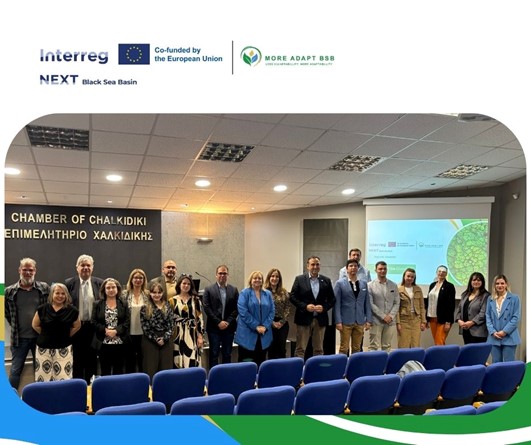
On 19-20 May 2025, the Chamber of Chalkidiki successfully hosted the Knowledge Exchange Group Meeting of the MoreAdaptBSB project (BSB00479), at its Conference Hall in Polygyros, Greece
The event brought together project partners, policymakers, scientists, and regional stakeholders from Greece, Bulgaria, Romania, and Ukraine, under the framework of the Interreg NEXT Black Sea Basin Programme.
The central theme of the event was:
“Green Space Restoration and Climate Resilience in the Black Sea: Challenges and Opportunities.”
The meeting opened with a warm welcome and an overview of the project’s objectives and upcoming activities, delivered by representatives of Chamber of Chalkidiki and Ovidius University of Constanta. This was followed by two thematic panel sessions:
- Panel 1: Practical Challenges and Opportunities in Climate Restoration
Moderated by Jenny Eleme, the panel featured contributions from Stathis Avramidis (Deputy Regional Governor for Development & Environment, Region of Central Macedonia), Eirini Bouliou (President of Municipality Council, Municipality of Kassandra), Ilias Kalfas (Head of Innovation HUB, American Farm School), and Giannis Papagiannis (Forestry Expert), highlighting real-world issues and local solutions for ecosystem restoration.
The discussion focused on environmental and geographical data from Central Macedonia, the impact of climate change in the region, mainly on annual temperature, rainfall, and the effects on the cultivation and production of olive oil, honey and wine.
- Panel 2: Policy Alignment and Funding Opportunities
Led by Eleni Siapikoudi, this session included insights from Dimitrios Lokovitis (Civil Protection Unit, Halkidiki), Stathis Avramidis (Deputy Regional Governor for Development & Environment, Region of Central Macedonia), Ioannis Koufidis (President of the Chamber of Halkidiki), and Lina Tsaltampasi (Green Strategy Consultant, OECON Group), discussing governance pathways and funding strategies for long-term restoration.
More precisely, Mr. Lokovitis emphasized on the European and national legislation for climate change adaptation and resilience and the work that the civil protection administration is conducting in Greece. Moreover, Stathis Avramidis, Deputy Regional Governor for Development & Environment, Region of Central Macedonia, made a general statement on the National and Regional Plan for Climate Change and Restoration in Central Macedonia and argued that climate change has a strong impact on everyone’s lives and cooperation is the key to dealing with this challenging crisis and especially Chalkidiki is of high importance and all funding opportunities are being utilized.
In the afternoon, Via Pontica Foundation presented the project’s remote sensing methodology and received feedback from partners and experts, and all inquiries were addressed to proceed with the local research. After that, a workshop was developed by EPICHAL titled “Co-developing Local Restoration Strategies”, where participants jointly shaped context-specific solutions using Nature-based Solutions (NbS) approaches and shared their common limitations and strategies for the future.
The meeting concluded with an open discussion, reflecting on shared learnings and the way forward toward regional cooperation for climate resilience.
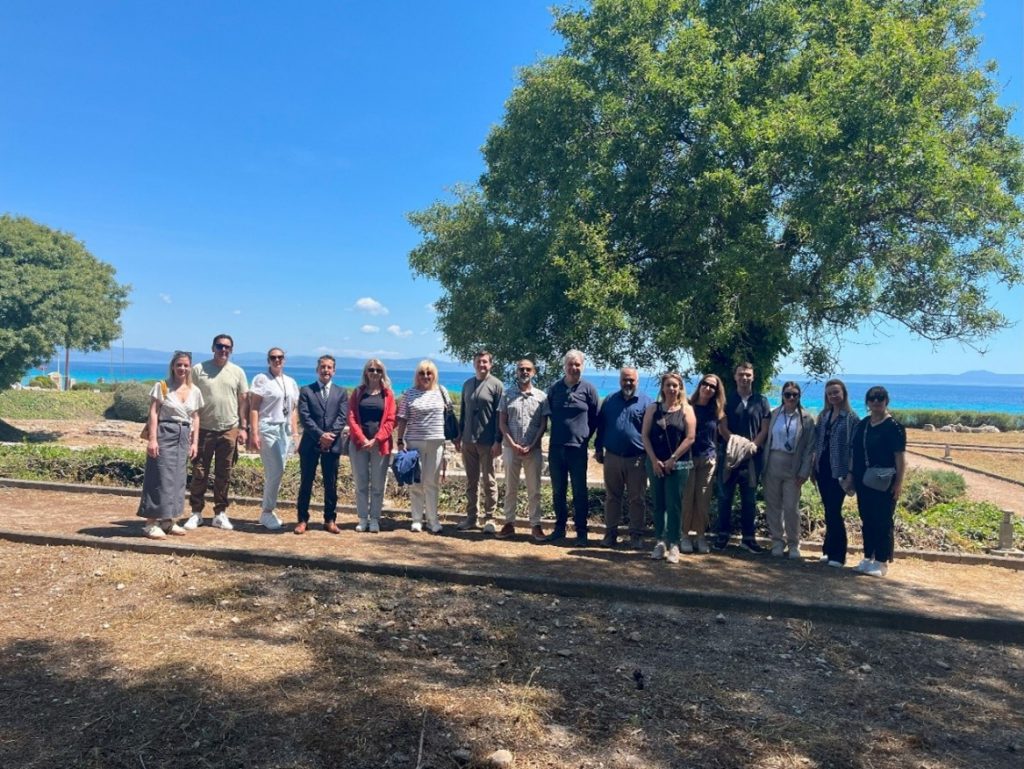
During the 2nd day of the meeting, a field visit to Kassandra was held and the consortium visited cultural and environmentally significant regions in the Municipality. The Mayor of Kassandra, Anastasia Chalkia, the President of Municipal Council Eirini Bouliou, the Vice-Mayor for Economics Margaritis Papastefanou, the Vice-Mayor for Tourism Lazaros Gatsios and the Vice-Mayor for Environment Pavlos Patzikis, in cooperation with the organizers Dimitris Mintos and Dimitra Mitka from the Chamber of Chalkidiki, provided vital information for the restoration and environmental activities in Chalkidiki and the upcoming pilot site in Kassandra.
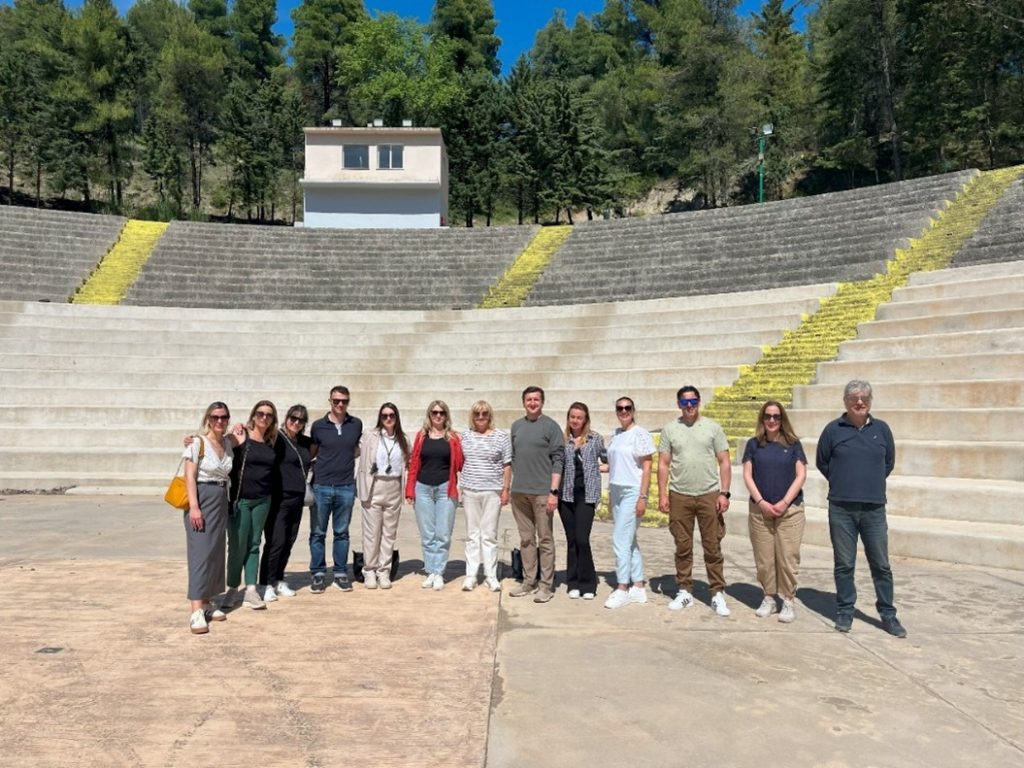
Partners expressed their positive feedback on the conducted activities and discussed the upcoming Knowledge Exchange Meetings in Constanta, Romania and Primorsko, Bulgaria. Ten months have passed from the beginning of the project, and the consortium has been extensively working on promoting nature-based solutions and regional cooperation among our countries.
This meeting is part of the project “Less vulnerability, more adaptability – pilot remote sensing assisted restoration of green spaces in coastal and urban areas within the Black Sea region” (MoreAdaptBSB – BSB00479), co-funded by the Interreg VI-B NEXT Black Sea Basin Programme.
Follow our pages to learn more about our project and upcoming activities.
“The project is being implemented between July 26, 2024, and January 25, 2027, and has a total value of €1,594,728, of which €1,435,255.20 is funding provided by the European Union through the Interreg NEXT Black Sea Basin Program. As a partner, Primorsko Municipality receives contracted funding of 250 765.20 euros.”
 0
 0

 0